


Tuesday, March 27, 2007
Genshiro Kawamoto as social scientist
Who would think that a person described as "an eccentric real estate tycoon" would be responsible for an experiment that brings into play social issues such as race, class, occupation, overthrow, and even--it's not much of a stretch--reparations:
Aside from the concern over Kawamoto's history--that he may fail to maintain these properties as he has failed to maintain others he has owned in the past--is the boldness of what he has done.
While discussion in print and on the web has often drifted to "racial" issues, there are other viewpoints possible. One is that in truth, Kahala is built on land originally belonging to the native peoples of this island. Before the mansions appeared, I believe breadfruit and taro (?) were cultivated there. I visited the UH library map section several years ago and found farmland there and perhaps graveyards (hard to spot on the maps they have). It would have taken more research than I had time for then to learn details of Kahala's history.
Now that some descendants of the original people have been injected into the community in an unexpected and unpredicted way, it will be interesting to see if current residents welcome back the children of their original hosts. Will they be at least civil, if not welcoming, to their new neighbors? Or will they attempt to re-establish their sovereignty over their "territory?" Did they feel "safe" and now feel "threatened?" How exactly do they feel?
The families who have accepted Kawamoto's invitation can be thought of as pioneers in a sense, re-entering a land that used to be theirs. No doubt they might have accepted a similar offer had Kawamoto proposed housing in another neighborhood, but here they are in Kahala. I'm sure they know that they have moved into a potentially hostile environment.
The new tenants face discrimination in many ways. Kawamoto began the discrimination even as he welcomed them to his properties, since they cannot have pools or fences like their neighbors have. Why can't they have pools? Maybe there are good reasons, but it's clear that they are not like their neighbors who are allowed to have pools. And so they are discriminated against from the very beginning.
Discrimination at least on a class basis is part and parcel of whatever is happening in Kahala. Would the rich residents feel the same about people who the South calls "white trash" moving into their neighborhood? Do they only welcome those like themselves who have bought into their enclave? Will class differences be disguised as racial issues? How will the racism that certainly exists manifest itself?
I'm interested in knowing if Kahala's newest residents are able to borrow tools from their neighbors. Have they been invited over for dinner, do neighborhood kids offer to mow their lawns? Indeed, what is the quality of their neighbors' interaction with them so far?
Let's see not only how it goes, but how the discussion goes. Let's see how the newspapers and TV frame the issues. Let's see whether they move beyond focusing on Kawamoto himself to analyzing how Hawaii reacts to this experiment in social justice.
The first Hawaiian family may move into one of Genshiro Kawamoto's million-dollar homes on Kahala Avenue as early as January and pay only $150 to $200 a month in rent, the Japanese billionaire said.This will be interesting to watch, of course. The experiment has only just begun. How it will develop is anybody's guess.
Kawamoto yesterday announced that he's moving ahead with a plan he floated last month to provide affordable housing in O'ahu's priciest neighborhood.
The 74-year-old eccentric real estate tycoon, who has baffled observers with past Hawaii investments and charitable visions, said he aims to have nine homes occupied by April, preferably by needy Hawaiians.
Aside from the concern over Kawamoto's history--that he may fail to maintain these properties as he has failed to maintain others he has owned in the past--is the boldness of what he has done.
While discussion in print and on the web has often drifted to "racial" issues, there are other viewpoints possible. One is that in truth, Kahala is built on land originally belonging to the native peoples of this island. Before the mansions appeared, I believe breadfruit and taro (?) were cultivated there. I visited the UH library map section several years ago and found farmland there and perhaps graveyards (hard to spot on the maps they have). It would have taken more research than I had time for then to learn details of Kahala's history.
Now that some descendants of the original people have been injected into the community in an unexpected and unpredicted way, it will be interesting to see if current residents welcome back the children of their original hosts. Will they be at least civil, if not welcoming, to their new neighbors? Or will they attempt to re-establish their sovereignty over their "territory?" Did they feel "safe" and now feel "threatened?" How exactly do they feel?
The families who have accepted Kawamoto's invitation can be thought of as pioneers in a sense, re-entering a land that used to be theirs. No doubt they might have accepted a similar offer had Kawamoto proposed housing in another neighborhood, but here they are in Kahala. I'm sure they know that they have moved into a potentially hostile environment.
The new tenants face discrimination in many ways. Kawamoto began the discrimination even as he welcomed them to his properties, since they cannot have pools or fences like their neighbors have. Why can't they have pools? Maybe there are good reasons, but it's clear that they are not like their neighbors who are allowed to have pools. And so they are discriminated against from the very beginning.
Discrimination at least on a class basis is part and parcel of whatever is happening in Kahala. Would the rich residents feel the same about people who the South calls "white trash" moving into their neighborhood? Do they only welcome those like themselves who have bought into their enclave? Will class differences be disguised as racial issues? How will the racism that certainly exists manifest itself?
I'm interested in knowing if Kahala's newest residents are able to borrow tools from their neighbors. Have they been invited over for dinner, do neighborhood kids offer to mow their lawns? Indeed, what is the quality of their neighbors' interaction with them so far?
Let's see not only how it goes, but how the discussion goes. Let's see how the newspapers and TV frame the issues. Let's see whether they move beyond focusing on Kawamoto himself to analyzing how Hawaii reacts to this experiment in social justice.


Sunday, March 18, 2007
Ha! And you thought you didn't have to worry about Net Neutrality?
It's already happening, though not yet on the Internet (not on the Internet that we know of, anyway). Check out this article on Undernews, Big Phonies Block Free Conference Calls.
Wireless companies Sprint, Cingular, and Qwest have started blocking the phone numbers of at least one free conference service that competes against their own more expensive offerings.
A more complete discussion can be found here.
While the issue has its complications, bottom line is that the cellphone companies are blocking their users from calling these services. This should give us a taste of what will happen if we don't get firm laws in place to protect Internet neutrality.
The landline phone companies are prohibited from blocking access to phone numbers whether or not they like them. The same rules seem not to apply to wireless services, and so they are blocking your access to services they don't like but you might want to use.
If you want to stay in touch with the Net Neutrality issue or take some action on your own to keep the Internet free and accessible, a good start would be to go to the Free Press website or the Save The Internet website.
Wireless companies Sprint, Cingular, and Qwest have started blocking the phone numbers of at least one free conference service that competes against their own more expensive offerings.
A more complete discussion can be found here.
While the issue has its complications, bottom line is that the cellphone companies are blocking their users from calling these services. This should give us a taste of what will happen if we don't get firm laws in place to protect Internet neutrality.
The landline phone companies are prohibited from blocking access to phone numbers whether or not they like them. The same rules seem not to apply to wireless services, and so they are blocking your access to services they don't like but you might want to use.
If you want to stay in touch with the Net Neutrality issue or take some action on your own to keep the Internet free and accessible, a good start would be to go to the Free Press website or the Save The Internet website.
Saturday, March 17, 2007
BOE wins award for darkness during Sunshine Week
In order to be fully informed these days it's necessary to read a few blogs along with the daily papers. I forgot to read Ian Lind's blog yesterday, so caught up with his Friday post today. It's a long and important one.
Towards the end he reported that the Hawaii Board of Education had won a Big Island Press Club Lava Tube Award "for defying the state Office of Information Practices’ directives to make public the minutes and audio tape of the meeting at which charter schools director Jim Shon was fired in September."
"Sheesh," I thought at first, before the fog lifted from my brain, "here I do all the work and they get the award!"
I apologize for the thought. I read the blogs first thing in the morning, before enjoying my daily cup of coffee while reading the newspaper. Yes. The BOE is very deserving of this award. Thanks to the Big Island Press Club for giving them the recognition they deserve.
Towards the end he reported that the Hawaii Board of Education had won a Big Island Press Club Lava Tube Award "for defying the state Office of Information Practices’ directives to make public the minutes and audio tape of the meeting at which charter schools director Jim Shon was fired in September."
"Sheesh," I thought at first, before the fog lifted from my brain, "here I do all the work and they get the award!"
I apologize for the thought. I read the blogs first thing in the morning, before enjoying my daily cup of coffee while reading the newspaper. Yes. The BOE is very deserving of this award. Thanks to the Big Island Press Club for giving them the recognition they deserve.
Tuesday, March 13, 2007
Newspaper coverage of helicopter crashes deprives us of world news
Whether it's television news or our daily papers, "selling it" seems to be more important than balance. I noted when my lightweight edition of the Advertiser fluttered down on my doorstep this morning that for the second day in a row, huge pictures of the crashes had displaced other important news.
Pictures of helicopter crashes sell papers, of course.
It used to be that by opening to page 3 I'd find out what was going on in the world, more often than not the latest on the ongoing war in Iraq. But generous space has been given to color pictures of the helicopter crashes that frankly don't convey much information, while real news has been totally ignored. The world continues to turn, of course, but we are missing out on its important stories.
Certainly, two deadly crashes in a row is newsworthy. On a relative scale of things, though, isn't the coverage being sensationalized at the expense of news we need to have?
There comes a point where a newspaper that's on a strict diet risks losing its relevance. The six o'clock news adequately covers local crime and disasters. We usually count on a newspaper to continue covering real news, but it's not happening. Today's paper was anorexic and let us down on both world and national news. Would adding even a single extra page of world news have broken the budget?
We do have alternatives when the daily paper falls short (see the end of this post).
Are newspapers emulating the "vast wasteland" of television?
The deterioration of television is perhaps better documented. Here is one study on local content (there are several choices I could have used here):
Alternatives to the shrinking daily paper
If your interests go beyond two helicopter crashes, you can get a quick summary from a vast choice of Internet news sources. There's Google News and similar. For Iraq, to dig more deeply than the wire services do, try this list of Iraq blogs. There is also Headlines from Electronic Iraq. On the left side of this blog are some alternative sources, especially Democracy Now! which is a website, radio and also a television program all in one.
These alternative sources bring you real news, and they do the job that most daily papers, with their dependence on Associated Press wire news and a few other limited sources, can't do. For example, here is just one story you can read on the 'net today:
I enjoy browsing the front pages on the Newseum website.
On days like this, when my local paper lets me down, what choice is there but to go electronic and get information via the web? In the end, since a local paper can't afford the breadth and depth of coverage you can find on the Web anyway, you'll be better informed if those helicopter stories have sent you searching for real news elsewhere.
Pictures of helicopter crashes sell papers, of course.
It used to be that by opening to page 3 I'd find out what was going on in the world, more often than not the latest on the ongoing war in Iraq. But generous space has been given to color pictures of the helicopter crashes that frankly don't convey much information, while real news has been totally ignored. The world continues to turn, of course, but we are missing out on its important stories.
Certainly, two deadly crashes in a row is newsworthy. On a relative scale of things, though, isn't the coverage being sensationalized at the expense of news we need to have?
There comes a point where a newspaper that's on a strict diet risks losing its relevance. The six o'clock news adequately covers local crime and disasters. We usually count on a newspaper to continue covering real news, but it's not happening. Today's paper was anorexic and let us down on both world and national news. Would adding even a single extra page of world news have broken the budget?
We do have alternatives when the daily paper falls short (see the end of this post).
Are newspapers emulating the "vast wasteland" of television?
The deterioration of television is perhaps better documented. Here is one study on local content (there are several choices I could have used here):
In every year of the study, the No. 1 topic on local television news was crime. Over the five years, 24 percent of all stories were about crime - the number ranging from a high of 26 percent in 2002 to a low of 19 percent in 2000. (Some stations clearly go the other way. In 2002, the last year of the study, there were stations where crime represented as little as 5 percent of stories. But these were unusual.)That was a study of television, but how much of it would apply equally to our daily paper? Given the chance, accidents, fires, catastrophes and the occasional bizarre event seem to push real news off the few pages still left in the first section.
If crime was the No. 1 topic on local news by more than 2 to 1, what came next? Over the five years, stories about accidents, bizarre events, fires and catastrophes accounted for 12 percent. Taken together, crime, fire accidents and disasters made up 36 percent of all stories.
Alternatives to the shrinking daily paper
If your interests go beyond two helicopter crashes, you can get a quick summary from a vast choice of Internet news sources. There's Google News and similar. For Iraq, to dig more deeply than the wire services do, try this list of Iraq blogs. There is also Headlines from Electronic Iraq. On the left side of this blog are some alternative sources, especially Democracy Now! which is a website, radio and also a television program all in one.
These alternative sources bring you real news, and they do the job that most daily papers, with their dependence on Associated Press wire news and a few other limited sources, can't do. For example, here is just one story you can read on the 'net today:
Malnutrition among children under fiveEvery major US newspaper has a web presence, and you can take a world tour by visiting the websites of international papers such as the Guardian of London, the Independent, or the International Herald Tribune.
8 March 2007
Apart from dodging bombs and bullets in their schools and neighborhoods, children in Iraq are suffering from worryingly high levels of malnourishment, according to specialists. Poverty and insecurity are said to be the main causes of the children's deteriorating diets. Despite efforts by NGOs and the Iraqi government, violence and the displacement of hundreds of thousands of people are making it very difficult for monthly food rations to reach those families that need them most. According to the United Nations Children's Agency (UNICEF), about one in 10 children under five in Iraq are underweight and one in five are short for their age.
I enjoy browsing the front pages on the Newseum website.
On days like this, when my local paper lets me down, what choice is there but to go electronic and get information via the web? In the end, since a local paper can't afford the breadth and depth of coverage you can find on the Web anyway, you'll be better informed if those helicopter stories have sent you searching for real news elsewhere.
Thursday, March 08, 2007
OIP to Board of Education: What part of "you can't charge $880 for an audio tape don't you understand?"
I thought this was over, but the Office of Information Practices kindly wrote one more letter to the Board of Education about their extortionary exhorbitant excessive (and as it turns out, illegal) charge of $880 for a redacted audio tape of the secret meeting when they fired popular charter school executive Jim Shon.
If for some reason you still care about this at all, you might recall that just a few days ago I wrote that even though OIP informed BOE chairperson Karen Knudsen that "Chapter 2-71, Hawaii Administrative Rules, does not allow an agency to charge a requester the cost to reproduce the requested record for the agency's purpose of redacting the record", she basically wrote back that she plans to charge the $880 anyway.
(Any kids reading this? What a great example this BOE is setting for you--ignore the law whenever you want, it's ok. Imagine if kids followed Knudsen's example in school.)
Today's OIP letter reiterates their previous instruction and sets a deadline of March 15 to release the information.
One thing I would like to point out--of all the State agencies I have dealt with over the years, OIP has worked hardest on my behalf. They take the open meetings and open records law seriously, and from this exchange you can see that they go the extra mile for the average citizen.
If the Department of Transportation worked this hard, we'd have fewer pedestrian deaths. You see what I mean. Here is one part of our government that is really there for us. I want to express my thanks for all of the effort that OIP has put into this, while at the same time contrasting that with the BOE's behavior starting with the firing of Jim Shon in an illegal secret meeting right through to their current coverup of their action.
The information is so old at this time (it should have been released before the November elections) that this fight is not worth pursuing. In fact, demonstrating the BOE's and Knudsen's disdain for the law has been worth far more than whatever is on that audio tape.
Although voters wanted the information on who voted to fire Jim Shon before the November election and didn't get it, maybe this coverup will still be remembered by the next one.
So I've made a note in my calendar to blog a reminder before the next election.
If for some reason you still care about this at all, you might recall that just a few days ago I wrote that even though OIP informed BOE chairperson Karen Knudsen that "Chapter 2-71, Hawaii Administrative Rules, does not allow an agency to charge a requester the cost to reproduce the requested record for the agency's purpose of redacting the record", she basically wrote back that she plans to charge the $880 anyway.
(Any kids reading this? What a great example this BOE is setting for you--ignore the law whenever you want, it's ok. Imagine if kids followed Knudsen's example in school.)
Today's OIP letter reiterates their previous instruction and sets a deadline of March 15 to release the information.
One thing I would like to point out--of all the State agencies I have dealt with over the years, OIP has worked hardest on my behalf. They take the open meetings and open records law seriously, and from this exchange you can see that they go the extra mile for the average citizen.
If the Department of Transportation worked this hard, we'd have fewer pedestrian deaths. You see what I mean. Here is one part of our government that is really there for us. I want to express my thanks for all of the effort that OIP has put into this, while at the same time contrasting that with the BOE's behavior starting with the firing of Jim Shon in an illegal secret meeting right through to their current coverup of their action.
The information is so old at this time (it should have been released before the November elections) that this fight is not worth pursuing. In fact, demonstrating the BOE's and Knudsen's disdain for the law has been worth far more than whatever is on that audio tape.
Although voters wanted the information on who voted to fire Jim Shon before the November election and didn't get it, maybe this coverup will still be remembered by the next one.
So I've made a note in my calendar to blog a reminder before the next election.
Gag order may keep escort service phone numbers away from public view
Do you remember that Washington DC escort service that threatened to sell its telephone call list? Who knows what famous people's numbers might be found in the 46 pounds of itemized data.
Well, our fun may be spoiled. The prosecutors are trying to get a gag order. They have filed a motion to keep the phone numbers under wrap. Read about it here.
Shucks.
Well, our fun may be spoiled. The prosecutors are trying to get a gag order. They have filed a motion to keep the phone numbers under wrap. Read about it here.
Shucks.
The New York Times runs its own foreign policy campaign
It seemed during the run up to the Iraq war that the invasion was led not by troops but by the drumbeat of New York Times articles. There was a sort of "mea culpa" long after the articles had their effect and after things had already started to go very wrong with the occupation. Public sentiment had switched against the war before the Times moved to admit, partially, their role in it all.
They're off again, creating a special "New York Times" version of foreign policy, with today's coverage of President Bush's visit to South America.
Before Iraq was in the Times' crosshairs. Now it's Iran, and of course Bush Administration policy against Venezuela's democratically elected leader Hugo Chavez. And again, the New York Times is taking the lead, softening up the public for Bush moves to follow.
I was stunned to read in today's Times article, Visit by Bush Fires Up Latins’ Debate Over Socialism
You figure out what's going on. Not in Sao Paulo, that's clear from other stories. I mean, what's going on with the New York Times.
They're off again, creating a special "New York Times" version of foreign policy, with today's coverage of President Bush's visit to South America.
Before Iraq was in the Times' crosshairs. Now it's Iran, and of course Bush Administration policy against Venezuela's democratically elected leader Hugo Chavez. And again, the New York Times is taking the lead, softening up the public for Bush moves to follow.
I was stunned to read in today's Times article, Visit by Bush Fires Up Latins’ Debate Over Socialism
President Bush has portrayed his trip to Latin America this week as a “We Care” tour aimed at dispelling perceptions that he has neglected his southern neighbors.The "smattering of protests" and "graffiti" are in contrast with other news reports. For example, CNN's report today, Bush faces widespread opposition in Latin America reported a much more serious protest:
But fresh graffiti on streets here in São Paulo, where he landed Thursday night for his first stop, calls him a murderer. The smattering of protests and the placement of military vehicles around the city, South America’s largest, also present an alternate interpretation of his visit: as a clash between the open capitalism that Mr. Bush espouses and the socialist approach pushed by leftist leaders who have grown in power and popularity.
On Thursday, police and protesters clashed in Sao Paulo, Brazil, hours before Bush arrived Thursday evening, The Associated Press reported. No protesters were visible on Bush's route to the city from the airport, but earlier about 6,000 people gathered for a largely peaceful march against Bush, the AP said.The Los Angeles Times also noticed much more than just graffiti on the streets. In their story, In Sao Paulo, Bush greeted by thousands of protesters they wrote:
Riot police fired tear gas at protesters, sending hundreds fleeing and ducking into businesses to avoid the gas, the AP said. Several protesters said police beat them, according to the news agency.
As President Bush flew here aboard Air Force One on Thursday, thousands of protesters shouting, "Out Bush!" marched down this city's main drag, Avenida Paulista.Of course, the Times would not want to be accused of distorting the news. The very last paragraph of their story, if you got that far, does indeed report on a bit of actual unrest in Sao Paulo:
Hundreds of riot police flanked at least 6,000 protesters near the city financial center, and the scent of tear gas hovered along the march route. At least three protesters and a news photographer were reported hurt as baton-wielding police and protesters clashed, but there was no immediate word on their condition. Authorities later said that 16 police officers suffered minor injuries.
Later, the Brazilian news media reported that police officers used tear gas and batons on protesters who were throwing rocks and struggling with the officers, sending hundreds of demonstrators running through the streets of São Paulo. There were no major injuries reported.Got that? Only "hundreds of demonstrators."
You figure out what's going on. Not in Sao Paulo, that's clear from other stories. I mean, what's going on with the New York Times.
Tuesday, March 06, 2007
Pedestrian thrown 40-50 feet, killed by driver in same dangerous stretch of Farrington Highway
I'll bet there were no police anywhere near the dangerous intersections on Farrington Highway where residents have both complained about the need for more traffic lights and that there are already too many traffic lights. Clearly, pedestrians are not being protected against speeding drivers.
The latest victim was an 80-year woman hit in a crosswalk and sent flying in broad daylight. The newspaper stories are here and here.
Just where are the police? This part of the Star-Bulletin story describes a trickle of police enforcement:
Helloooo.... it's the drivers that are killing the pedestrians. Why so few tickets? And why not over there on Farrington Highway, so drivers will learn to slow down and obey traffic laws?
 I'll bet police could issue 100 citations an hour at the crosswalk near where I live. And they should. And also near the crosswalk where you live.
Drivers have been warned they need to slow down and shape up. It's in the papers and on TV. They already got their warnings.
Again, I need to say it: these deaths are blood on the hands of the city and state because traffic laws are not being enforced. Only 25 citations. Sheesh.
You can help by calling the mayor's office. His phone is 523-4141 and his email is mayor@honolulu.gov . Tell him, enough already, put more police to work at intersections. Now.
The latest victim was an 80-year woman hit in a crosswalk and sent flying in broad daylight. The newspaper stories are here and here.
Just where are the police? This part of the Star-Bulletin story describes a trickle of police enforcement:
INTERCEPTIONS AT INTERSECTIONSSo skip the "no insurance" citations, they have nothing to do with traffic violations. Net result? 25 citations issued to pedestrians and a mere 10 to drivers!
Of the 25 citations issued Sunday to pedestrians on Oahu:
» Fourteen jaywalked.
» Nine crossed the roadway against a blinking red pedestrian signal.
» Two crossed the roadway with a steady red pedestrian signal.
Of the 16 citations issued to drivers:
» Six failed to yield to pedestrians.
» Four disregarded a red traffic light.
» Six were cited for miscellaneous offenses such as no insurance.
Source: Honolulu Police Department
Helloooo.... it's the drivers that are killing the pedestrians. Why so few tickets? And why not over there on Farrington Highway, so drivers will learn to slow down and obey traffic laws?
I'll bet police could issue 100 citations an hour at the crosswalk near where I live. And they should. And also near the crosswalk where you live.Drivers have been warned they need to slow down and shape up. It's in the papers and on TV. They already got their warnings.
Again, I need to say it: these deaths are blood on the hands of the city and state because traffic laws are not being enforced. Only 25 citations. Sheesh.
You can help by calling the mayor's office. His phone is 523-4141 and his email is mayor@honolulu.gov . Tell him, enough already, put more police to work at intersections. Now.
Board of Education thumbs its nose at OIP, defies open meetings law
In the final round of letters between the Board of Education and the Office of Information Practices, BOE chairperson Karen Knudsen thumbed her nose at the OIP and the law one final time.
This is a family blog, or I would have characterized her response to the OIP in more colorful language.
Why "one final time?" There comes a point where the cost of getting the BOE to obey the law and release the information just isn't worth it. Time has passed. While learning who voted for the ouster of Jim Shon in that secret meeting before the election last year was of interest to the voting public back then, the election is passed and there is little incentive to continue the fight.
Since the BOE defied the OIP decision, my only recourse would be to go to court to pry the information loose. It's just not worth it.
This last round of letters demonstrates why we need to have more teeth in the open records and open meetings laws. What is it that Knudsen does not understand about "Chapter 2-71, Hawaii Administrative Rules, does not allow an agency to charge a requester the cost to reproduce the requested record for the agency's purpose of redacting the record"?
I'll be writing to the BOE to say that I will not pay the $880 and so enable their defiance of the law. Who knows what they will charge the next person?
If (yawn) you might still be interested in this, the last letter from the OIP to the BOE is here, and their defiant response is here.
Will other boards follow BOE's lead and put Tiffany price tags on K-Mart information to keep their back room conversations secret from the public? How much should we pay for information that is ours to begin with, by law?
This is a family blog, or I would have characterized her response to the OIP in more colorful language.
Why "one final time?" There comes a point where the cost of getting the BOE to obey the law and release the information just isn't worth it. Time has passed. While learning who voted for the ouster of Jim Shon in that secret meeting before the election last year was of interest to the voting public back then, the election is passed and there is little incentive to continue the fight.
Since the BOE defied the OIP decision, my only recourse would be to go to court to pry the information loose. It's just not worth it.
This last round of letters demonstrates why we need to have more teeth in the open records and open meetings laws. What is it that Knudsen does not understand about "Chapter 2-71, Hawaii Administrative Rules, does not allow an agency to charge a requester the cost to reproduce the requested record for the agency's purpose of redacting the record"?
I'll be writing to the BOE to say that I will not pay the $880 and so enable their defiance of the law. Who knows what they will charge the next person?
If (yawn) you might still be interested in this, the last letter from the OIP to the BOE is here, and their defiant response is here.
Will other boards follow BOE's lead and put Tiffany price tags on K-Mart information to keep their back room conversations secret from the public? How much should we pay for information that is ours to begin with, by law?
Sunday, March 04, 2007
6-year-old with autism arrested and read his rights by Hawaii police
 This is 6-year-old Koa Burgo, who usually attends Hookena School on the Big Island of Hawaii. He has been diagnosed with autism.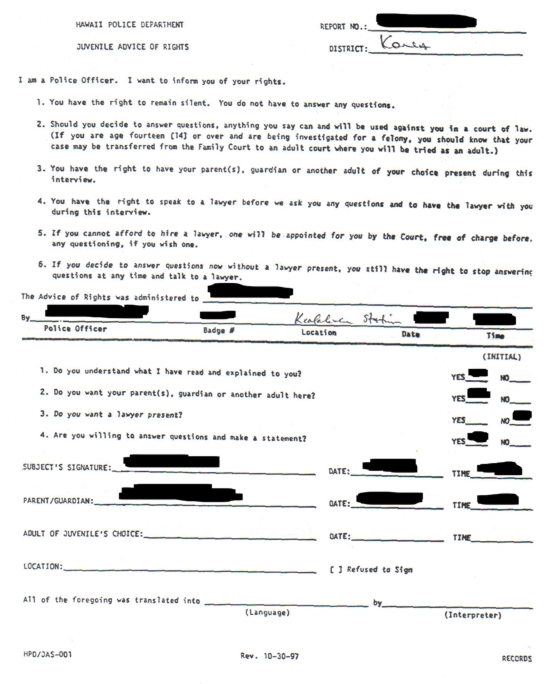
And this is the form police used to read him his rights when they arrested him for 2nd degree assault. Yes, a 6-year-old child with a disability has been charged and read his rights.
KITV reported on Friday that Koa jumped onto the back of his teacher after she told him to slow down when he was running. The teacher was injured and filed a TRO that is keeping Koa out of school.
Never mind federal law that describes the school's responsibility to have an educational plan in place that defines what to do if there is are behavioral issues. This is the Hawaii Department of Education, the one that was under federal court supervision for a decade because it couldn't provide basic services for Hawaii's special needs children.
Does the school have the required behavior intervention plan in place? If so, why wasn't it followed? The teacher is recovering and not in school, so why is there a TRO that prevents Koa from attending?
Koa's mother said that she has asked repeatedly for a one-on-one aide with training in autism. She said that he is still at a pre-Kindergarden level even though he should be at the first grade level. For children with autism, there is a window of opportunity which shouldn't be missed--they need (and the law requires they be given) the supports necessary to learn. If the school resists, the child may never make up the lost time.
Does this school understand autism and have they provided him with appropriate supports?
Arresting children for behavior such as having an outburst (which is common to some children with autism, especially if their educational needs have been neglected) or dropping or throwing pencils, for example, used to be quite common. Arresting these children does them no good, certainly.
Koa's mother said in the KITV interview that he needs help, not punishment. I think anyone would agree. Except for some police and school officials, it seems.
For Koa, and for other children with autism in Hawaii's schools, there will be a fork in the road after graduation. In one direction can be a college education and a good job. In the other direction could be dependence, loss of opportunity, or worse. Which road the student will take is determined by what happens at a very young age. Time is critical for this student right now. The DOE needs to begin working immediately for his success.
Many parents have said that the state has regressed badly since Judge David Ezra ended the Felix Consent Decree. Here's some evidence to support that.
Watada attorney has guts to demand Bush pay for war crimes
In a debate held at the University of Hawaii law school last week, Lt. Ehren Watada's attorney called for President Bush to pay for his acts, including, as the law requires, the ultimate penalty.
Will Eric Seitz's courage inspire others to openly discuss what has been simmering in the background for so long?
Today's Honolulu Star-Bulletin reports:
Of course, much will depend on whether Secret Service agents come busting his door down to carry him away. If a simple t-shirt gets them riled up, imagine how mad they could get about this.
Update: I sometimes cross-post to DailyKOS. I was impressed by a comment on this article by Private Keepout. Click over there and have a peek.
Will Eric Seitz's courage inspire others to openly discuss what has been simmering in the background for so long?
Today's Honolulu Star-Bulletin reports:
A longtime Honolulu litigator and defense lawyer, Seitz can be counted on for zeal as well as insight. And so the audience was not disappointed Tuesday as Seitz leveled a blistering broadside against President Bush, Vice President Dick Cheney and former Pentagon chief Donald Rumsfeld.Perhaps Seitz's high-profile statement will inspire others to debate the issue. Kudos to the Honolulu Star-Bulletin for carrying this story.
"Treaties, when they are properly adopted by this country, become part and parcel of American law," Seitz argued. "The president cannot select which treaties he is going to implement and ignore others. And his selective enforcement of the provisions of the law ... frankly, in my view, should subject him to a war crimes trial -- and, in fact, to the ultimate punishment which the statute requires, which is death.
Of course, much will depend on whether Secret Service agents come busting his door down to carry him away. If a simple t-shirt gets them riled up, imagine how mad they could get about this.
Update: I sometimes cross-post to DailyKOS. I was impressed by a comment on this article by Private Keepout. Click over there and have a peek.
Friday, March 02, 2007
The real story behind Lt. Watada's "mistrial"
So you thought you understood why a mistrial was declared by Lt. Col. John Head on February 7, 2007? Prof. Francis Boyle reveals the hidden story of why the court martial was aborted just before Lt. Watada would have taken the stand.
Of course, the government couldn't let Watada speak. Confirm your own suspicions or trade them for new ones. Read Prof. Boyle's explanation of what happened.
Of course, the government couldn't let Watada speak. Confirm your own suspicions or trade them for new ones. Read Prof. Boyle's explanation of what happened.
Thursday, March 01, 2007
Tort reform bill put to rest in House Judiciary committee
House Judiciary Chair Tommy Waters this evening made the most moving, poetic, and apposite short speech I've ever heard in the Legislature. I don't dare try to paraphrase it, I think I was in kind of a trance as he spoke. At the close of the hearing, he explained why he felt that committee members should vote to hold the tort reform bill (which kills it). I think his speech was persuasive, and indeed the vote was to hold the bill, HB220.
The hearing included testimony and videos from parents and relatives of children or spouses whose lives were shattered by medical malpractice in Hawaii. The mother of the baby given carbon dioxide instead of oxygen spoke. Others spoke of the man who was implanted with a screwdriver shaft. He ultimately passed away, after living in agony after the shaft broke shortly after surgery. As it happens, I included an early Star-Bulletin story on that case in my testimony in opposition to the bill.
It is certainly true that several medical specialties are in critically short supply on Neighbor Islands. This bill would not have corrected that situation, in my view, and I testified to explain that there is no assurance that it would reduce premiums. But it certainly would cut off funds to families suffering medical injuries such as those who testified at the Legislature today.
We need to solve the rural doctor shortage problem--I've written extensively in this blog that I feel a crisis is upon us already, and that if a storm or tsunami hit us today, we would not be able to deal with the demand for medical services. But the problem must not be solved on the backs of vulnerable patients.
If you can catch the testimony on Olelo, I'd recommend it. It will be very painful to watch. This is not M.A.S.H. or Dr. Kildare stuff. Keep a box of tissues handy. But if you can watch it, you'll understand, I think, why the media hype of "tort reform" may not offer the silver bullet so many doctors and others are hoping for. Doctors decide where to live and practice based on a number of factors. The high cost of malpractice insurance is one of them, but so is sending their children to a good private school or having a large enough practice to be economically viable. Perhaps there is a way to reduce the premiums (I cited this Star-Bulletin editorial, which suggests that one way would be to reduce Hawaii's high incidence of malpractice!).
No doubt a similar bill will come up again next year. Why not, in the meantime, work to solve our rural medical problems so that it wouldn't be necessary?
The hearing included testimony and videos from parents and relatives of children or spouses whose lives were shattered by medical malpractice in Hawaii. The mother of the baby given carbon dioxide instead of oxygen spoke. Others spoke of the man who was implanted with a screwdriver shaft. He ultimately passed away, after living in agony after the shaft broke shortly after surgery. As it happens, I included an early Star-Bulletin story on that case in my testimony in opposition to the bill.
It is certainly true that several medical specialties are in critically short supply on Neighbor Islands. This bill would not have corrected that situation, in my view, and I testified to explain that there is no assurance that it would reduce premiums. But it certainly would cut off funds to families suffering medical injuries such as those who testified at the Legislature today.
We need to solve the rural doctor shortage problem--I've written extensively in this blog that I feel a crisis is upon us already, and that if a storm or tsunami hit us today, we would not be able to deal with the demand for medical services. But the problem must not be solved on the backs of vulnerable patients.
If you can catch the testimony on Olelo, I'd recommend it. It will be very painful to watch. This is not M.A.S.H. or Dr. Kildare stuff. Keep a box of tissues handy. But if you can watch it, you'll understand, I think, why the media hype of "tort reform" may not offer the silver bullet so many doctors and others are hoping for. Doctors decide where to live and practice based on a number of factors. The high cost of malpractice insurance is one of them, but so is sending their children to a good private school or having a large enough practice to be economically viable. Perhaps there is a way to reduce the premiums (I cited this Star-Bulletin editorial, which suggests that one way would be to reduce Hawaii's high incidence of malpractice!).
No doubt a similar bill will come up again next year. Why not, in the meantime, work to solve our rural medical problems so that it wouldn't be necessary?
Analyzing escort service phone records
Thanks to today's edition of Undernews for this intriguing story: Woman who ran escort service may sell phone records to pay legal fees. It seems that a Washington, DC area escort service owner, Deborah Jean Palfrey, has been accused of running a money-laundering scheme from her Washington-based prostitution business, according to court records. To raise money for her legal defense, she has proposed to sell the phone records from the business--13 years of detailed records.
Instead of quoting snippets here, please go read the entire post, it's worth the click.
Well, I'll quote one little bit:
Also, if you click on the link for the data above or from her website, you'll get a pdf file with red redactions. I couldn't help but wonder what might be below the redactions, of course. It's human nature to wonder, isn't it?
How to analyze the data
First, if you're curious and have or know someone who has Adobe Acrobat or other software capable of working with pdf files, it's easy to see that the redactions have been done on the annotation layer of the document. So just remove the annotation layer (depending on your software, Document>Examine document). Yup, you have a clean, unredacted copy. Save it someplace. The redactions appear to be Orlando or Winterpark Florida phone numbers.
Next, either OCR the file for copy-and-paste or just manually type any phone numbers you are curious about into the Google search window and look them up! That's very simple research. And yes, it does come up with names and addresses. Of course, the owner of the phone number in 1966 may have changed, but who knows...
So now you have the method.
It's fun if you go for this sort of thing.
But for sure, if the 13 years of data is purchased, in a very short time some very interesting names may be discovered, given the location in Washington, DC.
This should be an interesting story to watch.
Instead of quoting snippets here, please go read the entire post, it's worth the click.
Well, I'll quote one little bit:
THIS IS ONE OF THE more novel defense tactics we've heard about. Palfrey's site says, "consideration is being given to selling the entire 46 pounds of detailed and itemized phone records for the 13 year period, to raise the requisite defense funds. An example from a randomly selected 6 day period in August of 1996 is available for review now."Of course, this data will be interesting to someone. Even the sample data, although it is from 1996, may yield some info because many people keep the same phone number over the years.
Also, if you click on the link for the data above or from her website, you'll get a pdf file with red redactions. I couldn't help but wonder what might be below the redactions, of course. It's human nature to wonder, isn't it?
How to analyze the data
First, if you're curious and have or know someone who has Adobe Acrobat or other software capable of working with pdf files, it's easy to see that the redactions have been done on the annotation layer of the document. So just remove the annotation layer (depending on your software, Document>Examine document). Yup, you have a clean, unredacted copy. Save it someplace. The redactions appear to be Orlando or Winterpark Florida phone numbers.
Next, either OCR the file for copy-and-paste or just manually type any phone numbers you are curious about into the Google search window and look them up! That's very simple research. And yes, it does come up with names and addresses. Of course, the owner of the phone number in 1966 may have changed, but who knows...
So now you have the method.
It's fun if you go for this sort of thing.
But for sure, if the 13 years of data is purchased, in a very short time some very interesting names may be discovered, given the location in Washington, DC.
This should be an interesting story to watch.
UH Economist reports state could save $33 million by ending failed war on marijuana
University of Hawaii Economist Lawrence W. Boyd's report, just release by the Drug Policy Forum of Hawaii, concludes that the $10 million spent on enforcement has failed to reduce the availability of marijuana in Hawaii:
Perhaps another benefit might be that more police would be freed up to do the important work of enforcing our traffic laws and reducing the pedestrian death toll.
in fact, marijuana prices have dropped, indicating efforts to restrict supply through law enforcement have failed. Approximately 65 percent of marijuana cases are dismissed, not prosecuted, or stricken, making the risk of arrest or punishment for marijuana use low.The DPFHI suggests that
Up to $33 million in new revenues and cost savings--enough to fund the entire statewide public library system, or ensure that all dams and reservoirs in Hawaii are safe--could be generated by a system of taxation and regulation to replace prohibition of marijuana in Hawaii,Following Boyd's advice would be a process no doubt taking several years. How to start?
"The first step toward these savings is ending criminal penalties for possessing small amounts of marijuana," [DPFHI President Pamela] Lichty said. Senate Bill 1296 and House Bill 1711 now before the State Legislature would make possession of less than one ounce of marijuana a civil violation rather than a criminal one. "That would save state and county governments about $5 million each year, and help deal with serious drug issues such as crystal methamphetamine," Lichty said.Boyd's report The Budgetary Implications of Marijuana Decriminalization and Legalization for Hawaii is available at the DPFHI website, in pdf form here, or as a text file here.
Perhaps another benefit might be that more police would be freed up to do the important work of enforcing our traffic laws and reducing the pedestrian death toll.


