Wednesday, April 28, 2010
Obama debt commission to geezers: buzz off
Obama's Debt Commission Co-Chair Tells Old People to Shut Up
On Tuesday President Obama formally launched a new commission that is supposed to bring down the national debt, in large part by investigating how entitlement programs, including Social Security and Medicare, can be cut back. . . The new commission, which is to file a nonbinding report by Christmas, has two co-chairs. Erskine Bowles, a former investment banker and Clinton chief of staff, is one of them. Alan Simpson, the quirky, conservative, longtime senator from Wyoming, is the other. The commission is supposed to be objective. But Simpson already has signaled that whatever happens, he wants to keep old people out of the process:
"You remember the last time we corrected Social Security, and people calling me. Let me tell you, everything that Bush and Clinton or Obama have suggested with regard to Social Security doesn't affect anyone over 60, and who are the people howling and bitching the most? The people over 60. This makes no sense. You've got scrub out (of) the equation the AARP, the Committee for the Preservation of Social Security and Medicare, the Gray Panthers, the Pink Panther, the whatever."
In other words, the geezers should all shut up, since they will all be dead by the time any entitlement reductions kick in. And what if they wanted to stick up for other old people in generations to come? Well, too bad. By the time those suckers hit retirement age, it'll be too late to do anything.
Note: Alan Simpson is 78 years old.
(Thanks to Progressive Review for pointer to this story)


New Jersey students mobilize to protect their education
Hawaii had its parent sit-in against Furlough Fridays and the shortest school year in the nation. New Jersey, also driven by Facebook and Twitter coordination, took to the streets to defend their education.
Michelle Ryan Lauto, 18, a college freshman, joined students who walked out of High Tech High School in Bergen County. It was Ms. Lauto's Facebook message urging students to take a stand against budget cuts that led to the protests around the state. "All I did was make a Facebook page," she said. "Anyone who has an opinion could do that and have their opinion heard."
The largest turnout was in Newark, where thousands of students from various high schools converged on City Hall.
The protest disrupted classroom routines and standardized testing in some of the state's biggest and best-known school districts, offering a real-life civics lesson that unfolded on lawns, sidewalks, parking lots and football fields.
At Columbia High School in Maplewood, that looked like 200 students marching around the building waving signs reading "We are the future" and "We love our teachers."
…
At Montclair High School, it meant nearly half of the 1,900 students gathered outside the school in the morning, with some chanting, "No more budget cuts."
In the largest showing, thousands of high school students in Newark marched past honking cars stuck in midday traffic to fill the steps of City Hall under the watchful gaze of dozens of police officers. [New York Times, In New Jersey, a Civics Lesson in the Internet Age, 4/27/2010]
(Thanks to Progressive Review for pointer to this story)
Is everyone out there critical of Hawaii legislature?
by Larry Geller
Yes, HB1212 is a travesty, hiding complaints from consumers. And introducing it at the very last minute ought to be a crime. And sure, someone will sue the state because high-tech tax credits were suddenly canceled. Maybe a couple of lawsuits, it’s their last chance to squeeze money out of the State before fleeing to the Mainland, which they would have done anyway without the government handout.
In fishing around for web references to the current legislative session, can you guess what I found the most of? You’ll never guess. Stuff like this:
#Hawaii legislature's bill to block viewing full #Obama birth cert exposes cover-up. What are he/they afraid of? I'll show mine! #teaparty 5 days
Yeah, the birthers have joined with the teabaggers, and they’re tweeting this up..
This from Yahoo Answers:
# Resolved Question: Is Hawaii Trying to Make a Quick Law to Deny USA Citizens Public Access to Public Records of Obama's Birth the?
# [Share] Resolved Question: Hawaii efforts to block access to public records?
And still more, and more…
Hawaii Legislature Votes to Ignore Birther Requests - AOL News 58 minutes ago
ShareHawaii Legislature Votes to Ignore Birther RequestsAOL News(April 28) -- Hawaii's state...
Now, they soon won’t be able to request copies of Obama’s birth certificate since the lege also passed a questionable “vexations requester” bill (see, plenty to not like this session), maybe they’ll fly to Hawaii to check in person, thereby boosting our tourism numbers.
We could ask Hawaiian Airlines to schedule special Birther flights, and since they have joined forces with those other loudmouths, why not serve free tea on board. Oh, and mixed nuts. Sweets to the sweet.
Ok, I’m frustrated, I need to go migrate this blog from Blogger FTP to something else today, I wanted to post one last article, and this is just how it came out. Now to light some incense to the gods of computing and see how this goes. I bought myself a couple of bags of M&Ms dark chocolate to see myself through the ordeal.
Tuesday, April 27, 2010
Legislature passes HB1212, shielding complaints from public records law
by Larry Geller
Hey, you didn’t call legislators? HB1212 passed and is now headed to Gov. Lingle. Complaints against dentists, barbers, doctors and other professionals will be shielded from the public records law unless the complaints are investigated and found against the professional. With few resources in this tight economy, most complaints may remain invisible, valid or not.
Governor Lingle may either sign the bill, veto it or let it become law without her signature. So if you would like to weigh in on this, you must speak with her. 586-0034. Don’t worry, she doesn’t answer her own phone.
Lawmakers shouldn’t be shy about a vote on HB444—you’re on record anyway
by Larry Geller
The popular wisdom is that state legislators are afraid to vote one way or the other on the civil unions bill, HB444, because this is an election year.
While voters may indeed have short memories, the Internet does not. Despite the voice-vote last time, thanks to the exit poll conducted by Adrienne LaFrance in the Honolulu Weekly (Roll Call, 2/3/2010) we already know basically where each stands. And that article will still be around come November.
So legislators need not be afraid to do the right thing. There already is a record.
The movement to get HB444 up for a vote is still strong and vibrant (see: Honolulu Advertiser, Hawaii civil union advocates aim to bolster lawmakers' support, 4/27/2010). It didn’t go away after the February vote.
When an advocacy movement is this persistent and has so much popular support, which is better, to respond to it now or to test whether it will be around at election time? This one shows every sign it will be back.
Boycotting Arizona?—Web shows how
by Larry Geller
Can a boycott of Arizona and its products and companies defeat their racist new anti-Latino law? A boycott has changed Arizona’s mind before. See the video below from that earlier protest, when the state refused to have a Martin Luther King holiday.
The new boycott movement is gaining steam on social media. To tune in, search for the hashcode #BoycottArizona (you don’t have to be a Twitter user to see the tweets, just click on the link).
One post that begins the process of listing up Arizona corporations to boycott is Boycott Arizona… here’s how: A basic consumer guide. You’ll recognize some companies with Hawaii presence right away:
Cold Stone Creamery. Headquarters: Scottsdale, Arizona
Go Daddy. Headquarters: Scottsdale, Arizona
Mesa Air Group (Mesa Airlines, Go!, Freedom Airlines). Headquarters: Phoenix, Arizona
P. F. Chang’s China Bistro. Headquarters: Phoenix, Arizona
Taser International, Inc. is headquartered in Scottsdale, Arizona, USA (just for info, why am I not surprised that they are based in Arizona?).
Ok, here’s that music video from the last Arizona boycott.
Arizona immigration law either a crisis or an opportunity for Obama
by Larry Geller
However one feels about legal or illegal immigration (a policy dispute I'll set aside to focus exclusively on potential electoral impacts), the actions of President Obama and his Administration will undoubtedly be a key point of focus as Latinos--who voted for Obama over John McCain by more than a 2:1 margin in 2008--decide whether to turn out this November and/or how to vote if they do show up. [FiveThirtyEight.com, Obama, Immigration and The Latino Vote, 4/27/2010]
As outrage with Arizona’s new law that codifies racial profiling grows across the country, the stinky ball has been dropped squarely in Obama’s court. If all he does is condemn the law verbally and “closely monitor the situation” instead of taking some kind of effective action, it’s certain that he will alienate yet another of the constituent groups that put him and fellow Democrats into office in 2008.
Imagine an Obama presidency with even fewer Democrats in Congress. The Fox News loudmouths who called for Obama to “fail” will have something to crow about in November.
So, much depends on whether Obama can do more than just talk a good line. Arizona is what it is. The outrage will devolve onto Obama himself because he is not supposed to tolerate what Arizona now represents.
Pierre, hire this guy. On second thought, please don’t
by Larry Geller
Ian Lind not only posted a gem of investigative reporting this morning (see: ilind.net, Mayor pushes to use special land conservation funds to augment rail’s transit oriented development, 4/27/2010), but he then followed with a valuable tutorial on how investigative reporting is done (The rush of reporting).
Please read both articles. I’ll snip Ian’s lead to encourage you to go over there:
Millions of dollars set aside in a fund intended to be used only for important land conservation projects could instead be diverted to provide open space or parks along Honolulu’s proposed rail transit route if Mayor Mufi Hanneman’s administration has its way.
But the chair of the commission established by the City Council to administer the special fund says it would be illegal under current law for Hannemann to do an end run around the commission in order to take control of the conservation funding.
I’m sad that the people of Honolulu are allowing a mayor to so devote and divert the county’s resources to this project that it appears he will stop at nothing, even sacrificing our quality of life, to make his train more appealing.
Where is that Superman that I remember as a kid, who stood in front of the speeding train with outstretched arms and sweating and straining, was pushed backwards for hundreds of yards before he finally stopped the thing (and saved Lois Lane, by a hairbreadth).
As I read Ian’s articles just now I was thinking what a catch he would make for Peer News. On the other hand, if that meant that he would be sequestered behind a paywall, lost to those of us who don’t believe in gated communities for special people, I’d rather Pierre leave him alone. Or Pierre, you could just push that Donate button that Ian and other bloggers have someplace on their website.
The best news on the web is still free, strange but true.
But I would like to add something to fill out the Mufi picture suggested above. I can’t claim to have investigated this, I do get many tips, leaks and suggestions. Here’s one that refers to a meeting to which the Mayor was invited:
Last night [Thursday, 4/22/2010], Mufi Hannemann attended Honolulu Community College's 90th anniversary Luau. The event was held to honor distinguished alumni. After a few minutes of pleasantries, he immediately jumped on promoting his train focusing on the benefits of a rail station at HCC. No mention of course of the potential for huge traffic jams around the campus during and after construction. What is appropriate to sell the train during an event meant to honor alumni accomplishment? You be the judge. Someone needs to whisper into his ear that he is turning into a caricature of himself.
Invite hizonner to your luau and you get a train pitch it seems.
Since the report is from a trusted source (thank you, source), I’m happy to bring it to reader attention. Add this anecdote to Ian’s excellent investigative report for a little more insight into the juggernaut that this transit project has become.
Monday, April 26, 2010
Disappeared News may disappear briefly
by Larry Geller
Blogger.com, owned by the great Google that can seemingly do anything, has said that it can no longer support blogs published via FTP. This includes my blogs and a huge number nationwide. So we have to “migrate” to something else by May 1st. Which is just around the corner.
I originally paid for the Blogger premium service just so I could take advantage of FTP publishing. So this is my reward.
I’d like to maintain my links if possible, so the move is not trivial. For example, I get a constant stream of hits just on the subject of Chinatown rats (the video is finally leveling off at about 33,000 views). Comments come in on articles that are months old. Etc., etc.
So I have to decide where to migrate, whether to continue with Blogger.com or make the leap to WordPress or some other platform, and what will become of the thousands of earlier articles.
Knowing that the playful gods of computer science are salivating over this opportunity, I suspect that the transition won’t be instantaneous.
So if Disappeared News disappears for a bit, please come back and check later.
Newspaper readers continue exodus to web
by Larry Geller
Weekday circulation at the San Francisco Chronicle dropped more than 22 percent in the last year to 241,330, according to figures released Monday by the Audit Bureau of Circulation. [San Francisco Business Times, S.F. Chronicle circulation drops 22 percent, 4/26/2010]
Yikes!
Overall, major newspaper circulation was down around 8.7% for the year ending March 31, according to the same ABC report.
Circulation at major newspapers around the country, including The Boston Globe and The Boston Herald, continued to drop as more readers get their news online, according to figures released yesterday. [Boston Globe, Globe, newspapers across US see circulation fall, 4/26/2010]
Readers are flocking to the web.
Where, by the way, news is free. I mention this only because a certain Hawaii web startup which shall remain nameless, plans to charge. [dig, nudge, poke]
[John F. Sturm, chief executive of the nonprofit Newspaper Association of America], however, added that traditional circulation data no longer tell the “whole story’’ about the health of newspapers because more people are getting their news on the Web. Nielsen Online reports that newspaper websites attracted a record 74.4 million unique visitors per month on average in the first quarter, he said.
Sunday, April 25, 2010
Disappeared memory: 2008, dear editor, was an election year
by Larry Geller
2008 was an election year, as is 2010. Election years are not the best time to expect truth-telling from ambitious politicians. This realization could have transformed today’s Advertiser editorial into a valuable lesson for any still gullible readers. It certainly might answer the question the editor is asking.
Today’s Honolulu Advertiser editorial, The high cost of economic optimism (4/25/2010) questions why Governor Linda Lingle, “one of the state's most intelligent and analytical executives,” described Hawaii’s economic condition as "stable and healthy" back in 2008 even as our economy was collapsing. Aloha Airlines and ATA Airlines had just shut down, yet she ignored the bad news:
The point of this trip in the way-back machine isn't to embarrass Lingle, but to point out how ill-prepared Hawai'i's leaders were to deal with the budgetary horrors that were to come.
It's still hard to understand why Lingle, one of the state's most intelligent and analytical executives, shrugged off the loss of 18 percent of the state's air capacity and didn't see that it would deeply wound the tourism industry. That, in turn, helped reduce tax collections by more than $1 billion from 2007 to 2009. (Two years later, the air capacity still hasn't fully returned.)
It was an election year. Speculation was rife that Linda Lingle could be chosen as McCain’s running mate on the Republican ticket. So ambition might have been the motive when she spouted that “stable and healthy” economy line just then. News reports of a failing Hawaii economy would hurt her prospects for something national. And that’s exactly what was in the air at that time, Google turns up numerous articles like these:
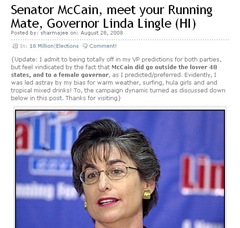

The hype was so strong here that the Maui News mixed editorial opinion into its news coverage asking “Why Lingle?”:
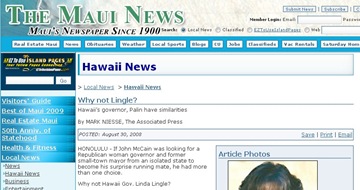
Speculation was rife that Lingle was hoping for some national appointment even after Republicans chose Palin for the VP spot. Lingle left Hawaii to campaign for the McCain ticket, never mind the faltering economy and other problems needing her attention.
The editorial also omits that Lingle has indeed been a penny pincher, though perhaps not in the Ariyoshi mold. One of her first vetoes was for $43,000 in services for the blind. She has withheld money from vitally needed senior services. There was no hesitation about shutting down the only Club House providing support to the mental health community on Molokai. There's a clear pattern to this.
The moral of the tale
2010 is an election year as well. Television is swamped with commercials for the 1st Congressional District candidates.
As we listen to those boasts and promises, maybe we should keep in mind the unwritten lesson of today’s editorial. Politicians, spending corporate money to gain election, will say whatever it takes to convince you to vote for them.
If we picked our elected representatives by their voting records or experience rather than by their rhetoric, wouldn’t we have a better government than we have today?
Saturday, April 24, 2010
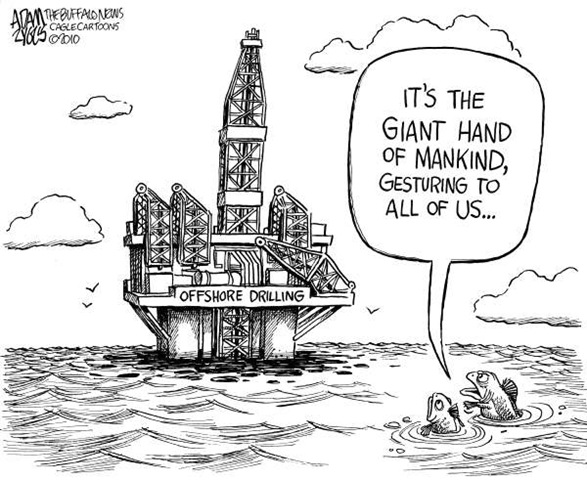
Dear President Obama: Here’s one reason why you should not have approved off-shore drilling
by Larry Geller
Coast Guard says 1,000 barrels of oil daily are leaking from destroyed rig off Louisiana's coast – AP
Friday, April 23, 2010
Hawaii lawmakers dealing with questions of high-tech vs. economic recovery
by Larry Geller
The State Legislature will act on two bills next week that affect so-called high-tech tax credits. You still have time to weigh in on them. You can bet that corporate interests are already doing so. One way or the other, your emails can make a difference.
Although I don’t know details of their deliberations, lawmakers have so far also declined to divert money to Governor Lingle’s darling deal with NASA for $138,000 that would pay for exactly one job in Hawaii. That expenditure is not in the budget, according to this AP story.
The bills you can weigh in on are SB2401 and SB2001. The first is a temporary suspension of the high-tech tax credits. The second “Extends the tax credit for research activities for one year. Repeals the technology infrastructure and high technology business investment tax credits effective May 1, 2010.”
If you have a position for or against these bills, send emails or call your legislators before Tuesday, April 27, when the conference committee should decide their fate. You can send to all legislators using sens@capitol.hawaii.gov and reps@capitol.hawaii.gov . Or, the conferees are House: M. Oshiro Chair; Chong, Choy, M. Lee, Ward, and Senate: Kim, Chair; Fukunaga, Co-Chair(s); Kidani, Kokubun, Hemmings.
As regular readers of this blog know, I have argued against offering high-tech tax credits without a comprehensive economic plan in place that will assure companies remain here when the handouts expire.
I wrote in Time to drop Act 221 and use the money for social services and job creation (2/9/2009)
For incentive tax credits to work, they have to be accompanied by structural changes. That is, unless we taxpayers intend to subsidize these private companies forever, when the tax credits are over, there has to be something different about Hawaii that causes high-tech companies to want to stay here. Otherwise, guess what—they’ll be making plans to leave even before the handouts end.
Sure, there is some high-tech here, it would be strange if there were none, but we should not count any program that needs Act 221. If it can only survive with tax credits, we don’t need to have it. We can’t afford it.
…
There are many good reasons (location, location, location are three) why Hawaii will not be the high-tech center of anything, with a few possible exceptions. It is still necessary to bring in parts and talent from elsewhere. Aside from the military, we lack access to customers. Meanwhile, other areas of the world are looking more attractive.Ok, so we provide tax credits, and it works for some companies. They stay here. Maybe they create jobs in Idaho, though, instead of in Hawaii. There’s nothing we can do about that now. Their management does whatever is necessary to qualify for the tax breaks, they go surfing in the early morning and after work, but create jobs and build their products in factories on the Continent.
One after another company has left Hawaii. It’s a parade of companies that were once the darlings of our high-tech promoters. Each leaving, one after the other, as the siren song of success called them to more suitable locations.
And in Disappeared taxes: Giveaway for high-tech is probably a huge waste of our money, but who knows? (10/7/2006)”
If all Hawaii offers is tax incentives, it's unlikely that corporations will stay. Of course, they'll stay as long as we taxpayers offer them a handout. Who wouldn't? Turn off the money spigot, and what will keep them here? This question has to be answered for each and every company, or they should not receive the tax incentive in the first place.
DBEDT has a history of spotlighting new high-tech companies at the beginning of their life cycle. The latest wunderkind is splashed across the daily papers. Down the road the bean counters do come knocking, and the company leaves, or their stock sags. One after another. Recall all the hype around that real-estate project dubbed the "Mililani High-Tech Park." The bean-counter knock came for one star tenant after another.
The NASA deal lauded in the press would certainly be a good thing for UH and for some students but would be unlikely to result in many jobs in Hawaii. To be employed in the aerospace industry most graduates will have to go to the Mainland, where the jobs are located. If this reasoning is correct, then questioning an expenditure of $138,000 for this project seems very reasonable, given the current budget crush.
Think of all the other purposes to which $138,000 could be put.
School bills pass, parents hard work recognized
by Larry Geller
Twitter is amazing. These two tweets came in just moments ago:
sos808Min instructional minutes bill passes!!!! whoot whoot!!!!!! less than 20 seconds ago via Echofon
georgettedeemerConferees pass hb2377 which lays out process for appointed school board should voters approve the constitutional amendment.
And this one just followed:
After applauding parents for their work on this bill, conferees pass HB2486 requiring 200 day min. of class instruction http://bit.ly/bIxcPk 3 minutes ago via web
Here’s what the bill says: “Requires all public schools, including charter schools, to implement a minimum of two hundred days of classroom instruction, or an equivalent number of instructional hours, per school year. Effective 1/1/2099.”
Thursday, April 22, 2010
Does plan to increase Hawaii’s General Excise tax have backing enough to withstand a veto?
by Larry Geller
Concerned about how Hawaii will deal with its budget shortfall, what new cuts or new taxes may emerge from this legislative session? Here is the current GET recommendation that is circulating at the State Capitol.
The plan would increase the General Excise Tax temporarily and compensate low-income families It may be close to what the Legislature will pass over the next few days. Click “Fullscreen” to read.
download GET plan from ScribdEven should this pass both houses of the Hawaii Legislature, its fate is uncertain. Governor Lingle is ideologically opposed to any tax increase. A veto of a GET increase would likely not be overridden in the House, at least not without major arm twisting.
So where does that leave the budget? Even if the Senate passes the four revenue bills from the House that are currently deferred, these bills would also likely not have sufficient support for a veto override.
If revenue cannot be increased, then the Governor would reduce the size of government by as much as $250 million. Government services would be slashed well beyond anything we have currently experienced.
 Please keep those leaks coming. You can email your leaks to Disappeared News at leak@disappearednews.com.
Wednesday, April 21, 2010
Disappeared outrage
by Larry Geller
Many newspapers don’t cover news that reflects badly against our own country. The story of war crimes committed by US Special Forces in Afghanistan and the subsequent coverup did break into the national news.
Few accounts have the detail or pack the wallop that this one displays. It begins:
It was early morning on February 12, 2010, in the village of Khataba near the city of Gardez in Paktiya Province, Afghanistan. A local family was celebrating the birth of a child. Suddenly, gunfire erupted from a nearby rooftop striking two men, two pregnant women, their unborn children and an 18-year old girl. The two men appear to have been killed instantly. The women were injured and reported bled to death because the gunmen would not allow them to be taken to a local hospital. Other family members were forced out of the home and detained. The gunman turned out to be American special operations troops.
Realizing that they had killed seven innocent people, the Americans immediately began to create what would become a series of false stories and fabricated incidents. They would destroy evidence of this potential war crime and ultimately attempt to blame the killings on the Taliban. The killings might well have been accidental, but the cover-up was premeditated, intentional and criminal. [Kabulpress.org, Pentagon Invents Taliban Atrocity in Khataba, 4/19/2010]
So far, none of the perpetrators have been prosecuted. It’s not unusual, in the case of civilian deaths in Iraq or Afghanistan, for those responsible to avoid accountability, with the effect that the civilian death toll has skyrocketed. And as the article notes, this leads to endless recruitment opportunities for the Taliban, aside from the tragic loss of human life.
What is “disappeared news” about this incident, if it has been covered in the domestic press? The part we don’t see is an upwelling of outrage.
By not demanding that our country’s own war crimes be investigated and punished, we become complicit in them.
(Thanks to Viviane Lerner for pointer to this story)
Peer News, a.k.a. Civil Beat, emerges as a gated community
by Larry Geller
Check it out at Civilbeat.com. It’s a soft opening, with real news to follow starting May 4, not so far away.
Strangely, I learned it was up and going from a Chinese-language Google Alert:

Yes, everyone is watching Pierre Omidyar it seems. There is already considerable comment for the Googling, which is what happens when something so anticipated finally bursts its chrysalis.
The site is typographically attractive. There, I’m working on my critical nature by starting off with one of the first good things I noticed.
After waiting so long for “Peer News” I had to say “Civil Beat” 100 times to myself to see if it might transform into something as trippy off the tongue as “LA Times” or “SF Chron,” but so far I guess I haven’t got it.
[I find that I’m hesitating to write anything about Peer News right now, remembering the stumbling startup that killed New Pacific Voice, of which I was a part. Foolish but brave, I write on, however.] [Yes, I’m a bit envious.]
An article by Katherine Nichols caught my eye. Yes, it’s only a placeholder, but it ended:
You, too, can download the 269-page document. But why would you want to? That’s what I’m here for.
There’s no link to the report so I could not download it, which would be a convenience and should be an adopted rule, if I may suggest that. But I actually feel insulted a bit. Yes, I would want to download it myself and no, I don’t need interpreters of the news.
Ok, it’s a soft opening. Scratch all that. But what seems solid is that Civil Beat is a gated community rather than a civic square. By charging $20 a month and requiring a PayPal account it discriminates against those who can’t or won’t pay that cost of admission.
What exactly will $240 a year buy? That’s a lot of plate lunch or even sushi.
It’s the price of admission to the gated community so that I get to participate. My opinion, though, is really worth only the proverbial two cents on today’s wild west web. If that much. Actually, I’ve often felt that the Advertiser should credit back some of my subscription if I have to read their editorials. There’s a novel idea. Pay me to read crap.
So should I pay to be part of a discussion with people who are not really my peers? Where is the peer in this Peer News? This is the great experiment, I guess.
Nor do I think I want to pay $240 a year for something without sports or comics.
As if to underline this, my Advertiser bill came in yesterday. A full year (including Sunday comics, ads with discount coupons, Dave Shapiro and Lee Cataluna) is only $226.20. And my sub supports their website, which is Hawaii’s best source of breaking news.

<—52 weeks $226.20, no PayPal account required.
Now, this next find is enticing: the issue of how many jobs the train will bring. The end of it segues into a pitch to join in for a discounted $4.99. .

I wouldn’t mind offering that Mufi’s rail may not bring many jobs if contractors hire cheaper out-of-state or foreign workers.
Just like Peer News did.
Picking the best and brightest meant bringing in staff from the Mainland. Nothing wrong with that, just making the comparison with Mufi’s rail project. Pierre Omidyar went for quality that he couldn’t find right here in Hawaii. Contractors may go for affordable labor, which they can’t find here in Hawaii. Local content laws, if any should be applied, might run into problems under federal law.
But I won’t pay to say that, not yet, anyway.
So that’s my first impression. Let’s see what May brings.
Monday, April 19, 2010
Streetcars bring desire
by Larry Geller
 Here’s what Honolulu will miss if it lets Mufi build an expensive elevated rail line.
This article, from Buffalo Rising, demonstrates the vitality that grade-level transit brings along its right-of-way. Yes, they are referring to the success of Portland, Oregon:
To date, over $3.5 billion has been invested within two blocks of the streetcar system including in excess of 10,000 new housing units and 5.4 million square feet of office, institutional, retail and hotel space. [Buffalo Rising, Streetcars Making a Comeback, 4/19/2010]
With a noisy train overhead and shadows below, Honolulu will be denied that prosperity.
Other cities have caught on, though. The Buffalo Rising article begins:
Tucson, Seattle, Washington DC, Atlanta, Sacramento, Fort Lauderdale, New Orleans, Columbus, Providence, Fort Worth and Salt Lake City are just a few of up to 40 communities currently planning or building streetcar lines. Experts expect up to 22 cities could have lines under construction within two years.
What makes this boom possible is a change in federal policy. The article describes some of the changes and links to this one for more detail:
Up to 22 US cities could be laying track within two years.
Thanks to the Obama Administration, streetcars may soon be reintroduced into many cities that haven’t had them for more than 50 years.
Since the middle of last year, the US Department of Transportation and the Federal Transit Administration (FTA) have largely reversed policies of President George W. Bush that favored bus rapid transit and made it difficult to spend federal funds to build streetcar lines. [New Urban News, Streetcars are poised for a dramatic comeback, 4-5/2010]
As I’ve noted before, the development of a vital retail corridor along the transit route wouldn’t be limited to the Honolulu city center. The same opportunities would be available all along the route to Waianae. That’s right, residential, office, institutional and hotel construction blossoms when low-cost, convenient grade-level transit is available.
Many cities hope to match the success of Portland's system that opened in 1991. Its modern streetcars run on an eight mile loop from Legacy Good Samaritan Hospital, through the trendy Pearl District, downtown, and Portland State University to a new riverfront community- the South Waterfront District. Ridership is nearly four million annually.
That’s nearly four million potential customers to retailers along the right-of-way.
The current plan is much less flexible. While a grade-level system could go right to airport terminals, the current elevated line has an “airport” station that is some distance from the airport. Whether or not it will ever go into Waikiki is problematic since residents will resist having a train roar by their lanai’s or block their view planes. Federal judges have also objected to the elevated train passing by their office windows for security reasons.
Yet the City pushes on. Why? Follow the money.
Mufi’s train benefits developers big enough (and wealthy enough) to build up the station areas. The plan would enrich housing developers whose property values increase in Central Oahu. Of course, these folks are also the ones able to make campaign contributions and support candidates for elective office.
The mom-and-pop store which might see increased business if the tram stopped outside their door can’t match the economic might of developers.
For a video clip of the Portland experience see: Retailers will lose a bonanza if rail passes overhead in Honolulu (10/23/2009). For
(Thanks to Kevin Killeen for pointer to the Buffalo Rising article)
Friday, April 16, 2010
Parents present their plan to end Furlough Fridays
by Larry Geller
Parent groups held a press conference today at the State Capitol to present their own plan for dealing with Furlough Fridays. See videos at: Hawaii parents present $55 million plan to end school furloughs now - April 16, 2010 (CNN.com, 4/16/2010).
The plan would use funds from the Hurricane Relief Funds, and other state sources to eliminate nine furlough days, at a cost of $55 million. In addition, teachers would teach on six of what had been planning days, as they had agreed to do with the BOE. The plan costs about $7 million less than what Gov. Lingle has already offered to accept.
The Advertiser reports more detail and also reactions from BOE chair Garrett Toguchi and Governor Lingle. Please read the complete Advertiser story for the details. I’ll snip this one bit, admittedly out of context:
"It is critical that we address the furlough situation with a comprehensive solution that involves parents, teachers, and taxpayers in the solution," Lingle said in her statement. [Honolulu Advertiser, New plan emerges to eliminate 15 Hawaii teacher furlough days, 4/16/2010]
That’s new and refreshing, if sincere. If Lingle truly believed in including parents, she might have tried that last week when parents came to visit.
She also might stop asking parents to reason with the union. What most citizens want is an end to the damage Furlough Fridays are doing to Hawaii’s educational system and to the damage that is being done to children. Now is not the time for ideology, but for repairs.
She could drop charges against the arrested parents for a start, and then invite parent representatives to the table as participants in the solution.
That would be completely out of character, of course, but it could go a long way to patching up her tattered legacy.
BART transit sergeant shoots Taser at 13-year-old boy on bike, fortunately misses
by Larry Geller
Unlike the incident described in the article below, this officer wasn’t even disciplined. But all BART transit police are being required to temporarily turn in their Taser weapons.
The final straw, apparently, came after an April 1st incident when BART police sergeant who was responding to a call about an alleged assault at the Richmond BART station.
Multiple sources said the sergeant was pursuing a 13-year-old boy who was fleeing the scene on a bicycle and reportedly deployed his Taser at the teen through the passenger window of his vehicle.
Sources said -- and the police chief confirmed -- that the shot missed and the youth was uninjured, but that the way the Taser was used was raising numerous questions. [KTVU, BART Police Ordered To Turn In Tasers, 4/15/2010]
Can you imagine what would have happened if the sergeant had connected with his Taser??
The linked article includes a video report.
They should take Taser toys away from boy cops
by Larry Geller
Florida deputy shocks colleague on the behind with Taser in joke gone wrong (LA Times, 4/12/2010)
The guy zapped a female deputy on her derriere. He got a reprimand.
The Florida story on which the LA Times article is based is here. There’s a video, but it wouldn’t play for me.
They should take this cop’s toy away. Also, isn’t this sexual harassment? Neither article raised that point. "It was just a spur of the moment thing."
This is exactly how people get killed. Cops are walking around with these weapons that can kill and misuse them. Zap, honey, how’d you like that? Want some more? Not funny.
Money talks, money votes
by Larry Geller
David Shapiro posts his flASHback on the Web and then the Advertiser run it on Saturday, so I feel funny about quoting him before he appears in print, but this is just too good:
Sen. Daniel Inouye tried to dissuade the Democratic Congressional Campaign Committee from endorsing Case over his favored Hanabusa by donating $100,000 that lobbyists gave his campaign to the DCCC. It's a political form of re-gifting known as re-bribing.
Unfortunately there is no opportunity for candidates for any office who are not swimming in contributions to get any attention in the commercial media. The money they rake in from lobbyists goes to buy ads in the same media that cover the elections, and the news section follows the money, it seems. That $100,000 will buy lots of ads for Hanabusa.
So it’s a setup. We are supposed to consider as serious candidates only those who can attract these huge chunks of money. Inouye is demonstrating his power here. Unfair, perhaps, but the ability to attract the most money usually tracks the ability to win.
The other 11 candidates for the 1st Congressional seat might as well just quit now. Right? Seriously. We are supposed to elect our leaders, but it seems that money elects our leaders.
Why are there complaints that Hawaii has a low voter turnout each election? We’re smart, we see what’s happening. It’s not our little paper ballot that matters at all.
This is American democracy, and Inouye ha$ ca$t hi$ big vote.
Volcanic Ash—no, not David Shapiro this time
by Larry Geller
It’s Eyjafjallajokull, in Iceland, wreaking more havoc than even a prize-winning journalist can.
Be the first on your block to be able to pronounce the name of this volcano properly.
Download this Media File - (Right Click)
Ok, got it? Taken from this Wikipedia page.
 Check out NASA feature here, and awesome curated Flickr photo gallery here.
CNN iReport highlights Hawaii’s protest in its ‘Schools in trouble feature’
by Larry Geller
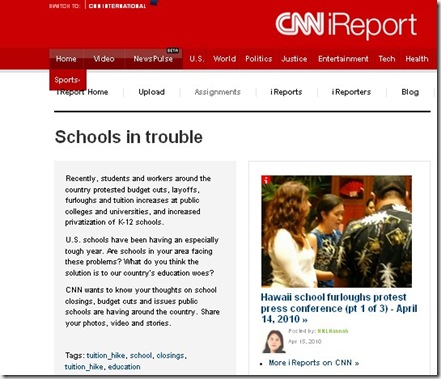
(click image to go to CNN page)
CNN’s experiment in citizen journalism allows anyone to submit stories, but “Only ones marked 'CNN iReport' have been vetted by CNN.” The next level up seems to be actual broadcast of the story.
‘Schools in trouble’ includes video of Hawaii Furlough Friday protest by Hannah Miyamoto. Snipping from her Twitter bio: “Lawyer, scholar, and almost 30 years of community activism. Former columnist, UH-Manoa student newspaper editor, frequent commentator.”
[Update: fixed some errors in the original post. Hope I got it right now.]
Google search asks “Going to Hawaii?” then warns about our school system
by Larry Geller
I thought the news would move on, but as of a few minutes ago (Friday), the parent protest still owns the key word “Hawaii” on Google News. Anyone trying to find what’s happening here will get this:
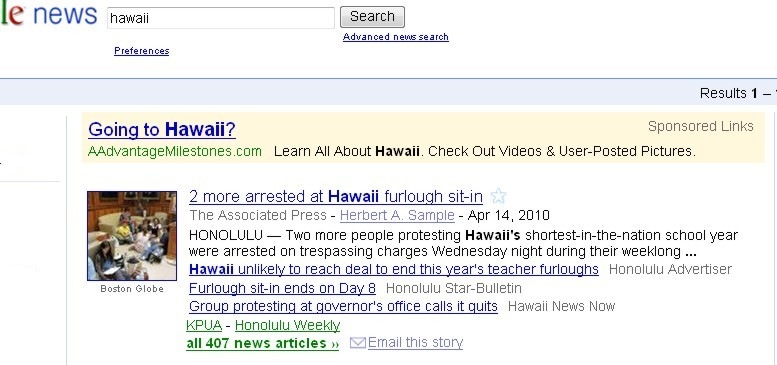
The “407 news articles” indicates significant coverage of the issue and sympathy on the part of editors (of course, it doesn’t indicate how many stories made it into print editions).
That paid ad on top is just an interesting juxtaposition.
Thursday, April 15, 2010
KITV uncovers anti-consumer stealth bill—to be heard in conference committee today
by Larry Geller
This is a bill that takes away important consumer protections. It was supposed to be dead, but now it is back. It will take public effort to drive a stake into its heart today. The conference committee meets this afternoon (Thursday) at 2:15.
 Standing applause to KITV for catching this one.
The spectre of HB1212 has “magically” appeared to haunt consumer advocates again this session (it died last session).
There appears to be a strong conflict of interest involved in its re-introduction and a clear loss to consumers if the bill should pass. The way to stop it will be to email, call and write before it is pushed through this afternoon at 2:15 p.m.
This bill, if it passes, will deny consumers the ability to learn of complaints against dentists and other licensed professionals until it may be too late. It has been pushed out suddenly at the last minute by Rep. Isaac Choy, whom Ian Lind identifies as a legislator with close ties to the bill’s key beneficiaries. See his expose this morning in Bill to limit consumer’s rights makes last-minute stealth move.
Ian writes, in part:
Russel Yamashita, registered lobbyist for the Hawaii Dental Association, one of the primary backers of this bill, is the chair of Choy’s campaign committee, Friends for Isaac W. Choy, according to the campaign’s organizational report filed with the Campaign Spending Commission. The Dental Association has consistently presented testimony and lobbied for this and similar bills over several legislative sessions.
Yamashita’s lobbyist registration and Choy’s campaign committee share the mailing address of several businesses in which Choy reports an interest (see his 2008 and 2009 financial disclosure reports), including Manoa Consulting Group LLC, Isaac W. Choy CPA Inc., Ukumaruku Corp., and K H Choy & Associates.
So we know who gains: the dentists and other licensed professionals who will be able to get the complaints hidden from public view, and Rep. Choy.
This bill could not have gone to conference without the approval of Speaker Calvin Say, and he has the power to stop it. His email is repsay@Capitol.hawaii.gov and his phone is 586-6100.
Don’t you want to know if there are complaints against a professional before you sit down on that chair? This bill will remove your ability to easily find out what problems others have reported.
Members of the House conference committee just appointed are: Karamatsu Chair; Choy, Mizuno, Thielen. The Senate appointed conferees last session, before the bill died. They are: Taniguchi, Chair; Takamine, Slom.
If the public doesn’t weigh in on this one, it will likely pass at 2:15 this afternoon.
Wednesday, April 14, 2010
Media interview with Eric Seitz posted on YouTube
by Larry Geller
This is a video from HSMiyamoto’s YouTube channel. Since it permits embedding, here it is for you. Note that attorney Eric Seitz mentions potential ACLU involvement.
Eric Seitz was one of the two main Felix attorneys and has represented clients including Erin Watada. More relevant to the Furlough Friday issue, he filed one of the two lawsuits in Federal Court last year attempting to enjoin the state from carrying out its plan.
Parents turn around Advertiser poll at 105 votes every 4 minutes / Do the Lingle Jingle
by Larry Geller
I’m in total awe, blown away, by the Internet savvy of the parents occupying Governor Linda Lingle’s office to push her to end the hated Furlough Fridays.
Of course, the most important thing, and the most regrettable, is that they are being arrested this evening. Why should parents be hauled off by sheriffs for standing up for kids education? World, please take note and support the parents.
But I’m also struck by the extent they have been using media to involve the general community in their effort. I’ve never seen anything close to this in Hawaii.
As the arrests are taking place, they video them and instantly post the videos. You can see the officers in their aloha shirts, how posh the governor’s digs are, and how cooperative the process is. I’ll bet the sheriffs have kids too, they are not beating up on anyone the way the might in New York City. You can see videos at this YouTube page.
Outside, others are posting Tweetphotos.
Voting phenomena
But that’s all supply-side economics. Who’s out there watching? Apparently lots of people. It’s a crazy late hour on the US mainland and in Europe, but when the parents asked for supporting votes in the Honolulu Advertiser online poll (see honoluluadvertiser.com) earlier this evening, there were 637 votes total, with about 63% voting “end it now” and 23% voting “keep it up till furloughs end.”
Then the parents tweeted for votes. I was called from my computer to eat dinner.
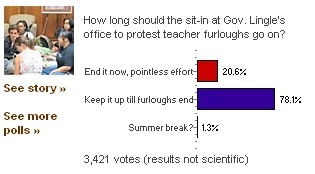 When I came back 24 minutes later, there were 1,371 votes, and the tide had shifted in the other direction. It didn’t stop there. As I type this, there are 3,421 votes (!), and the poll is running 78.1% “keep it up till furloughs end.”
I clocked it at about 105 votes every four minutes for awhile. That's an impressive following.
And I’m envious. If I asked my readers to do something like that, of the 14 or so of you out there, 2 might or might not make that call, send that email, or vote on a website.
The Lingle Jingle
But I think I’ll try anyway. First of all, please go vote on the website.  And tomorrow, how about do this. I’m inspired by the volunteers at Hawaii Public Radio asking their listeners to make the phone ring off the hook. They even have a collection of ancient phones with brass bells in them so you can hear them ring in the background.
So let’s do a Lingle Jingle. Whether you’re in Hawaii or not, please call Governor Lingle tomorrow, Thursday, at her office (808) 586-0034. The phones ring outside in the reception area where the parents are still sitting in. They’ll hear your support. If someone picks up, just leave a message for Governor Lingle asking her to end the furloughs NOW.
That number is 586-0034, or from the Neighbor Islands or elsewhere, 808-586-0034. Give the governor your message and ring that phone in support.
All 14 of you, please.
Also check their tweets for their legal defense fund and to stay current and in touch with them via twitter: @sos808.
Again, that number to call on Thursday is 586-0034.
Google data suggests that Hawaii sit-in story has spread to Europe/Asia
by Larry Geller
Aside from the critical importance of ending the Furlough Fridays that have positioned Hawaii as the state with the fewest instructional days in the country, I find I’m fascinated by how the story has caught on. It’s being carried by new and different newspapers and websites as it goes on from day to day.
The AP article from yesterday is making its rounds. Here’s a Google search I just did on the single word “Hawaii.” I searched on the single word to see what comes up when someone thinks they might come to Hawaii or is curious about Hawaii.
The pic at the left is from the Austin American-Statesman.
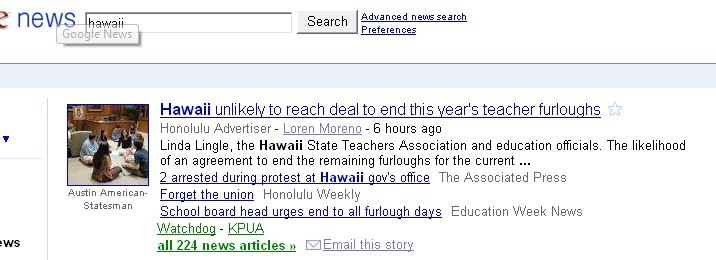
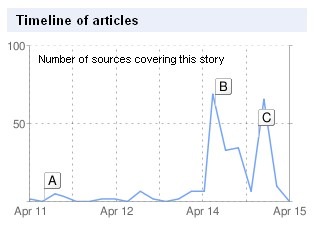
Google now makes a timeline available. Here’s the timeline showing the number of sources covering this story. While it’s still April 14 in the USA, it’s already April 15 in Europe and Asia. So I believe the timeline gives us a clue about how the articles spread world-wide.
A recent tweet advises that parents arrested will be represented by attorney Eric Seitz. Seitz was one of the lead Felix attorneys and also filed a lawsuit late last year against the furloughs. This will mean more articles tomorrow. Seitz attracts the media spotlight.
Hawaii’s kids are finally getting attention—but not, unfortunately, from the folks in Honolulu who can help them the most.
When leadership fails
by Larry Geller
If you think we have governor trouble here in Hawaii…
It’s hard to top Illinois for a leadership failure. Remember Blagojevich?
Here’s a court document that’s a hot item on the Internet right now. It’s from the case against Blagojevich. For a legal document, it’s a surprisingly good read, and might easily make the New York Times best seller list if someone would bind it as a book.
Snipped at random (really, I just moused down a bit):
From what Blagojevich said about appointments to boards and commissions, Monk understood that Blagojevich viewed those appointments as an opportunity to reward big fundraisers or Blagojevich’s supporters. Blagojevich consistently wanted to know who recommended a particular candidate for a board or commission slot. When Kelly and Rezko made their recommendations for people to be on boards and commissions, Monk knew that they were often rewarding people who had made contributions to Blagojevich or who were going to do so.
It’s also a good brain exercise. Here’s the next section I hit at random:
In addition to Financial Institution 1, Harris also spoke with Individual H, an executive at Financial Institution 2, about Blagojevich’s wife’s series 7 license. This meeting was in person at Individual H’s office. Harris asked him to keep her in mind if he heard anything about someone who did not do State of Illinois business. Individual H recommended a company called Financial Institution 3. Harris relayed this information to Blagojevich’s wife, who said that Financial Institution 3 was the company who had sponsored her for her Series 7 license. Harris told Blagojevich and his wife that he had asked Individual H to keep Blagojevich’s wife in mind and this had been his response. Blagojevich was very upset and told Harris that he wanted Individual H and Financial Institution 2 to no longer get anything from the State of Illinois.
I can’t resist one more. There’s so much in this document…:
On October 6, 2008, Blagojevich met with Lobbyist A at the offices of Friends of Blagojevich (“FOB”) offices. During their meeting, Blagojevich mentioned an upcoming announcement he was planning to make regarding a $1.8 billion project with respect to the Tollway. Blagojevich said words to the effect of, “I’ve got Lon going to Construction Executive and asking for $500,000” and “I could have made a larger announcement but wanted to see how they perform by the end of the year. If they don’t perform, fuck ‘em.” Lobbyist A knew that Construction Executive was involved with a trade association that would benefit from the proposed $1.8 billion project. Lobbyist A understood Blagojevich to mean was that he expected that Construction Executive would raise $500,000 in contributions to FOB and that Blagojevich was willing to commit additional state money to the project beyond the $1.8 billion but was waiting to see how much money interested entities raised for FOB before the end of the year.
The mistake heard ‘round the world: Gov. Lingle has protestors arrested
by Larry Geller
Thinking of taking a vacation in Hawaii and want to know what’s happening?
If you do a keyword news search on “Hawaii” right now, you don’t get golf, sun or surf news—you get this:
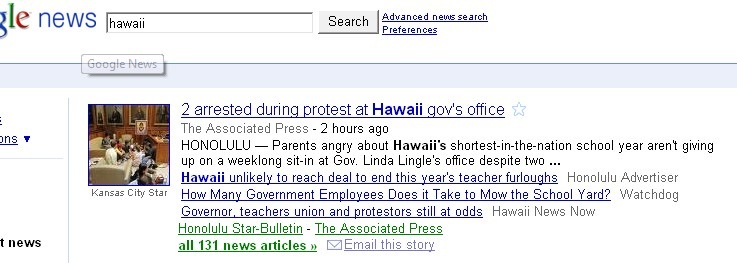
Yes, Governor Lingle has ordered Furlough Friday protestors sitting in at her outer office area to be arrested, and last night, two were hauled away in handcuffs.
Strategically, having protestors arrested generates favorable publicity—for the protest, because its values are sound. Who can be against education for the kids? Well, our governor, is the impression.
Very few Googlers who see the above will read the articles, but all will see “Parents angry about Hawaii’s shortest-in-the-nation school year aren’t giving up on a weeklong sit-in at Gov. Linda Lingle’s office….
Predictably, a news story about arrests in Hawaii of peaceful protestors has legs. More arrests will mean more bad publicity for the state.
The latest AP story making its way around the globe reveals the sad situation of Hawaii’s educational system while fingering the Governor as the key obstacle to getting the kids back in the classrooms:
"We know that she holds the power of the purse. She's the one who can release emergency funds to get rid of the furloughs for this school year," said Jill Tao, 45, who has two sons in public school. "We're parents. We're tired of having our children furloughed. We want it done now."
Thirteen days have been lost in the current school year, with four more furlough days slated in the coming weeks.
Another 17 days are scheduled for the school year that begins in the fall.
So far, 14 people have been issued citations for trespassing, and Lingle on Tuesday warned the protesters they risked arrest if they continued to try to remain in the office lobby overnight.
Later, two University of Hawaii students who remained after closing hours were arrested while eight others were handed trespassing citations, according to protester Marguerite Higa.
A telephone message The Associated Press left for Lingle spokesman Russell Pang about the arrests late Tuesday wasn't immediately returned.
On the local news front, David Shapiro’s op-ed on the editorial page of this morning’s Advertiser will be widely read: Gracious candidate now grumpy incumbent: Lingle's mishandling of sit-in invites all the blame for furloughs. Snipping from his article destroys his story development, but let me snip just this:
Imagine how much better things might have turned out if she had met with the group to politely listen to their concerns and explain why the state can't afford to accede to teachers union demands to run up the cost of ending furloughs by $30 million over the $62 million Lingle has offered by deeming every single school employee "essential."
I snipped this because I think it goes to the heart of the present standoff: Lingle remains unwilling to meet with very concerned parents who have demonstrated their commitment to Hawaii’s public education with great sacrifice for over a week.
And all she has to do is walk out the front door of her office and sit down and talk.